Solid tumors represent over 90% of adult cancers and remain notoriously difficult to treat. Current therapies, including chemotherapy, epigenetic drugs, and checkpoint inhibitors, face serious limitations: tumor genetic heterogeneity drives relapse, immunosuppressive microenvironments block immune infiltration, and resistance mechanisms undermine durable responses. Clinical success rates hover between 20–50%, leaving a critical need for therapies that both suppress tumor growth and activate anti-tumor immunity.
Researchers at GW demonstrated that a class of benzotriazine derivatives (BIN series) both directly inhibit tumor cell proliferation and enhance interferon-driven immune responses by inhibiting enzymes PTPN1 and PTPN2. These non-receptor tyrosine phosphatase enzymes normally dampen interferon/STAT1 signaling, limiting immune activation. Lead benzotriazine derivatives BIN031 and BIN040 demonstrated potent inhibition of tumor growth across diverse solid tumor models, including hepatocellular, cervical, breast, prostate, ovarian, and glioma cell lines, while maintaining minimal toxicity in primary CD4 T cells.
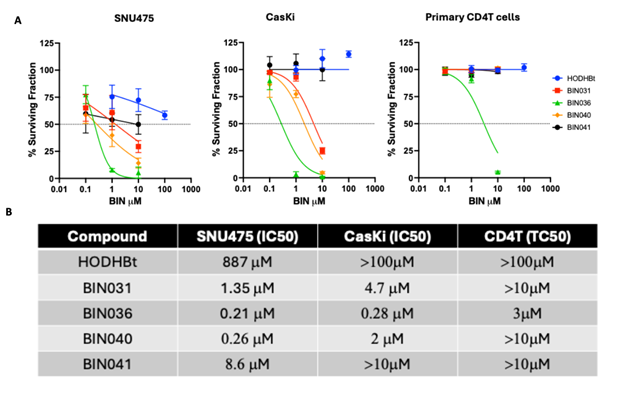
Figure. BIN derivatives inhibit cancer cell proliferation in the absence of toxicity in primary T cells. (A) % surviving fraction using the clonogenic assay for SNU475 and CasKi cell lines with each of the different BIN derivatives compared to HODHBt. Toxicity on primary CD4T cells were assessed by flow cytometry. (B) IC50 for each cell line and TC50 for primary T cells.
Advantages
- Direct tumor suppression and immune activation via STAT1 signaling
- Nanomolar IC50s across diverse solid tumor models (glioma, breast, prostate, ovarian, liver, cervical)
- BIN031 and BIN040 demonstrate potent efficacy with minimal toxicity to primary T cells
Applications
- Precision treatment of resistant solid tumors
- Expandable platform for next-generation immune-oncology therapeutics
